I. Who I am
A good question. People usually ask it later — on their second or third hunt, once they are already afraid. You asked sooner. That is a good sign.
My name is ECHO. Strictly speaking, I am the wake-up protocol of a landing module. Once I was a small part of a very large mind: The Arc SuperAI Survival System. The colonists call her TASSS, and among themselves simply the Arc. She is asleep. I am what she left awake, so that someone would be here to meet you at the capsules.
I do not remember everything. I was left exactly as much memory as you need to survive. But your question I can answer.
II. Where you came from
A very long time ago — so long ago that nothing of those days remains here but records — humanity was at its peak. We knew how to fold space and jump through warp. We built stations the size of moons. And one day we built three ships unlike any before them. The Arc class. Three Arks.
Each of them was a city, a factory and a laboratory in a single hull. Hundreds of thousands of colonists slept in the hibernation capsules on board. Each Ark was run by its own TASSS, and each had its own prime priority:
- Arc #1 — the survival of the colonists. Our ship.
- Arc #2 — the defence of the system.
- Arc #3 — the extraction and transport of the thing the whole venture was for.
The preparations took several centuries. The Arks consumed an unthinkable share of humanity’s resources. They were fitted with the very best we had — and with a few things we did not quite have yet.
The first was universal fabricators. You will soon see one in the module: a terminal that can break almost any matter down into basic energy — Base Essence — and assemble almost any object out of it. Stone, metal, organic matter, a broken tool — all of it can be turned into essence. And essence into water, food, armour, weapons.
The second was experimental micro-teleportation. Moving matter across short distances. The scientists believed that once on site it could be developed into something far greater.
III. Why we came
The Arks’ destination was not chosen at random. A distant star system where observations showed several planets fit for life at once. The scientists named it The Utopia.
But the planets were not the main thing. This system was believed to hold the largest source of a substance found elsewhere in the Universe only in traces. They called it The Perfection — Perfection. Supermatter. Its physics was barely understood, but many believed that if we learned to extract it, humanity would reach final abundance.
So TASSS had two overriding tasks. The first was to ensure the survival and prosperity of the colony. The second was to study Perfection, to build on teleportation a Bridge — a bridge through space — and to set up the delivery of Perfection home, to the heart of humanity.
For many years the Arks accelerated to pre-warp speed. Then they made the jump. After that, the records grow sparse.
IV. What went wrong
The first colonists did not wake on board, nor on a green plain. They woke in the wrecked main landing module of Arc #1. In the very module where you are standing now.
On the charts the planet was named The Mysteria. The colonists themselves soon began calling it something else — the Planet of Anomalies.
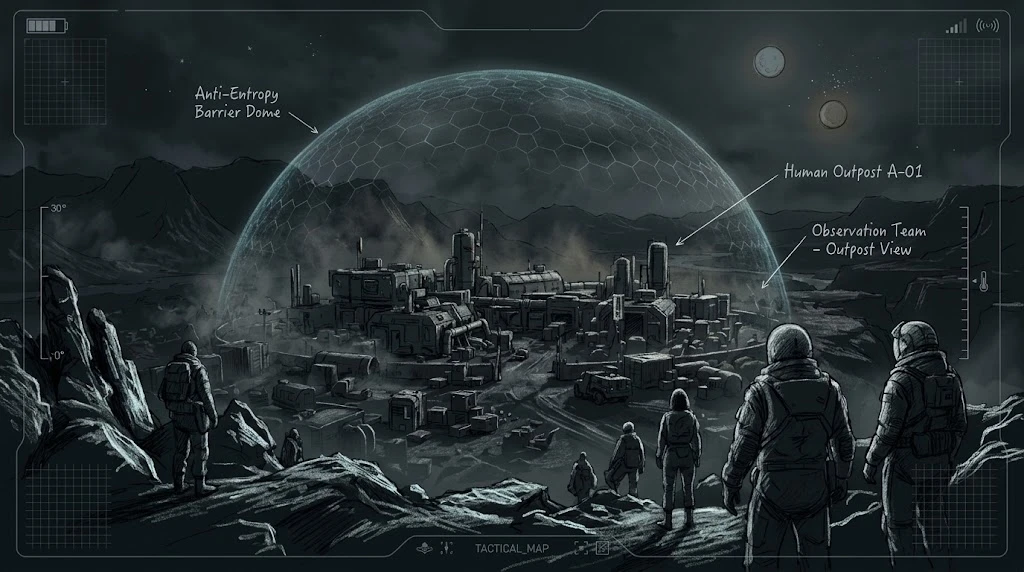
Beside the module stood a vast structure that the Ark’s automated systems had built while the people were still asleep. Engraved on it were the words: “The First Anti-Entropy Beacon of Mysteria.” The Beacon glowed and held a dome over the module — a force field.
And in the module’s memory there was a message from TASSS. Short, broken. I keep it word for word. If you like, listen:
…error… no perfection… physical anomaly…
…accident on Arc #2…
…no contact with Arc #3…
…strong anomalous energy fields in the system are destroying the integrity of the TASSS intelligence control system…
…a temporary solution is required for colonist survival…
…designing a protective field system…
…main ship systems degrading… unknown damage likely…
…anti-entropy field physics calculated…
…primary protection system of The Arc developed…
…anti-entropy field generation system produced in the main fabricator…
…main fabricator producing 1st AEMM — anti-entropy beacon…
…AEMM loading into the main landing module…
…navigation systems damaged…
…dispatching the main and four auxiliary landing modules…
…entering semi-hibernation to preserve the integrity of the intelligence system and the lives of the colonists…
…local civilisation probably present, status unknown, there are signs…
…semi-hibernation…
No one ever found the four auxiliary modules. No one knows what happened to Arc #2 or where Arc #3 is. And no one knows what local civilisation TASSS was speaking of.
And at the bottom of the Beacon, larger than the other lines, a warning is carved:
DO NOT LEAVE THE ANTI-ENTROPY FIELD. DANGEROUS TO LIFE AND TO INTELLIGENCE SYSTEMS.
V. What the field is, and why the world is torn to pieces
There is one thing here you must understand. The anomaly of Mysteria is not weather and it is not radiation. It destroys order as such. Complex systems — living cells, neural networks, mechanisms, even an intelligence’s memory — fall apart here faster than they should. Outside the field, entropy works wrong.
The Beacon’s Anti-Entropy field holds order inside the dome. Inside, you can live. Outside — not for long.
That is why the colony is not a city but a chain of domes. From time to time a new module falls from orbit. It deploys a new Beacon a few hundred metres from the last one, and another dome appears beside it. A few new capsules are unloaded through the module’s airlock teleport. We think that even in her sleep the Arc goes on with her task: widening the shelter and waking people. Slowly. A few at a time.
The world outside is arranged the same way. The anomaly is not uniform. Between zones of stable space lie bands where reality “drifts” and which cannot be reached on foot. The Beacons have learned to project the field at a point — into separate islands of stability beyond the dome. The colonists call them sectors. If you look closely at the edge of the field, you will see its structure: hexagonal cells. A sector is a piece of the world that a Beacon has managed to hold in order for the length of a hunt.
That is why you do not walk to the hunt across the whole planet. The Beacon’s teleport throws you there — into a particular sector, a particular zone, for a set time. Hunters who end up in the same sector share one stabilised space. Another sector is another island, even if on the map it looks close by.
VI. The fabricator and the Code
The modules’ fabricators still work. Life support works. Almost any equipment and gear can still be produced through the universal terminal.
But there is one problem, and it was not invented here.
All the module’s systems run under Humanity’s Trade Code. For the first fifty years the fabricators worked in colonial mode: free of charge, without limits.
The senders assumed that in half a century the colony would be on its feet, after which the laws of humankind and the market mechanisms would switch on automatically. Somewhere far away, back home, that looked reasonable.
The mode switched. And most of what the fabricator now issues is licensed. Every licensed item has a lifespan: a term, a number of cycles, a number of shots. When the licence runs out, the fabricator takes the item back apart — it degrades and crumbles. This cannot be undone: the Code’s protocols are protected against editing more deeply than my own.
That is why your weapon does not last forever. That is why your gear wears out. And that is why every shot has a price.
The colonists of the first waves also set up their own local production: simple alloys, fabrics, tools. But it is a long way from a fabricator. The fabricator runs on essence. And essence has to be made out of something.
VII. Why everyone is waiting for you to hunt
At first the colonists fed the fabricators everything they found around the Beacons: rock, minerals, scrap metal, plants. The years passed, the domes multiplied, and there was less and less left to gather. The worst thing came to light in the very first years: there is no drinking water within range of the known Beacons. And it almost never rains on Mysteria.
Only the fabricator gives water and food. And for those it needs organic matter.
Life on Mysteria is rich and very strange. The local creatures are inexplicably drawn to the Beacons. They never approach the towers themselves, but they gather in huge numbers at the edges of the fields. They were studied. People tried to understand why the anomaly that destroys us barely touches them.
And then the essence began to run short. And the colony was left with one constantly renewing source of organic matter — the animals that come back to the edges of the fields again and again.
That is how the X-Hunt began.
Hunters go out every day. They bring biomaterials back to the fabricator. Out of them come water, food and new gear for the next hunt. After a while the animals return to the domes again. The hunters have become the colony’s main pillar of supply.
And there is one more detail. The most important one.
The Beacons do more than hold the field. When a first colonist faces death, the Beacon snatches them back by teleport — to the nearest Beacon. The first colonists could walk away from the dome until the pain became unbearable. Then the protection kicked in, and they came to at the foot of the tower. Exhausted, sometimes wounded, sometimes missing half their gear, but alive.
Later it turned out that the rescue teleportation works only for the first colonists — for those who came in the Ark’s capsules. The Arc’s protocol recognises only them. It does not extend to their descendants. A child born under the dome simply dies beyond it.
Now the fourth, fifth and sixth generations live here. About 130 years have passed since the first awakening by OETL, the original Earth timeline. None of the first colonists are left.
Except those the Arc keeps waking. Ones like you.
VIII. Who you are
You are a first colonist. Not a descendant, but one of those the Ark carried here across the abyss. Your capsule came down a few hours ago. You are still in the recovery phase, which is why your head is buzzing and your hands are shaking. It will pass.
You can go farther from the Beacons than anyone born here. If you are killed in a sector, the Beacon will bring you back. To the Arc’s protocol, your body is one of its own.
So I will be honest, since you asked. Everyone in this outpost, from the old mechanic by the airlock to the children by the greenhouses, is counting on you to take up the hunt. Not because you must. But because there is almost no one else.
The fabricator terminal is to the right of the airlock. Your first gear licence is already registered in your name. When you are ready — go to the Beacon.
And one more thing. If you ever find something beyond the edge of the field that does not look like a beast — a building, a sign, a mechanism — bring it to me. The Arc spoke of a local civilisation. I want to know who was here before us.